
First Principles Come Last
Everyone says to think from first principles. Aristotle, who gave us the idea, said we reach them at the end. A thought experiment about why sentences drift when we speak aloud, and what they drift away from.
Before you read on, try something. It takes about a minute.
On a scale from 1 to 7, how well do you understand how a zipper works? Pick a number and keep it.
Now explain it out loud, step by step, as if to someone who has never seen one. What does the slider do? Why do the two sides hold together? Keep talking until you finish or get stuck.
Then do two things. Rate your understanding again. And remember the last sentence you said. Was it still about the zipper?
Everyone talks about first principles
Everyone talks about first principles. The phrase usually means: strip a problem down to what is certainly true and build back up, instead of copying what others have done. The version most people quote comes from Elon Musk. In a 2012 interview with Kevin Rose, as CNBC later reported, he imagined someone arguing that battery packs had historically cost $600 per kilowatt hour and would always be expensive, and asked instead what the materials inside would cost on the market. He sets this against reasoning by analogy: doing something because it resembles what was done before.
My own problem is smaller. Shaping sentences is hard for me when I talk aloud. Many of us get stuck when we think through an idea, each in our own way, and I have come to believe that getting stuck while articulating a thought is the same thing.
Here is the claim of this essay, plainly. Getting stuck while thinking and getting stuck while speaking are one failure: not yet knowing what everything else hangs from. First principles are usually sold as a place to start. In Aristotle, who gave us the idea, they are where you arrive. You begin with a confused whole. Speaking aloud is that arrival attempted in public, in real time, and a tangent is the sound of it not arriving.
There are no tips in what follows, only the idea, followed through.
What Aristotle said about first principles
Aristotle's Physics opens with the claim the slogan is built on: we do not think we know a thing until we know its first principles and have carried our analysis down to its simplest elements.
Then comes the part the slogan leaves out. The natural route, he says, runs from what is clearer to us toward what is clearer by nature, and those are not the same things. What is plain to us at first, in R. P. Hardie and R. K. Gaye's translation, "is rather confused masses," whose principles we come to know later, by analysis. A name such as round means a vague whole, and a definition is what takes it apart. A child calls every man father, and only later tells them apart.
So there are two orders. In the order of explanation, principles come first. In the order of discovery, they come last. "Start from first principles" quietly swaps the two. You can present an argument from them once you have them. I do not think anyone begins there.
First principles are where thinking ends up, not where it starts.
This, I think, is what happens when a sentence fails aloud. I am holding a name for the idea, not its definition. The name feels like understanding. The sentence asks for the definition, and I find out, in front of someone, that I do not have it yet.
Why the zipper felt easier than it was
In 2002, Leonid Rozenblit and Frank Keil of Yale University published "The misunderstood limits of folk science: an illusion of explanatory depth" in Cognitive Science. People rated, on a seven-point scale, how well they understood devices such as a zipper or a flush toilet, then wrote a step-by-step causal explanation and rated again.
In their second study, 33 Yale undergraduates rated their understanding at 3.89 on average before explaining, 3.10 after writing an explanation, and 2.49 after trying to answer a diagnostic question about the device. Twelve other students rated the written explanations at 2.72, closer to the deflated ratings than to the first. The authors called this the illusion of explanatory depth. It was strong for devices and natural phenomena, modest for geography facts, and absent for film plots and procedures.
Two of their reasons matter here. A fact has a clear end: you can name the capital of England or you cannot. With an explanation, they write, one usually has "little idea of what the final explanation will look like." And we rarely give explanations, so we have little record of our failures. Stories, we tell all the time.
A story carries itself: each event leads to the next, and you know when you have reached the end. An explanation has to hang from something underneath, and you cannot see where it ends. My reading, and it is only a reading, is that when the thing underneath is missing, the easiest way to keep talking is to turn the explanation into a story.
What a tangent is
In geometry, a tangent touches a curve at a single point and goes on without it. In psychiatry the word is narrower. Nancy Andreasen's Scale for the Assessment of Thought, Language, and Communication, published in Schizophrenia Bulletin in 1986, separates three neighbours. Tangentiality is replying to a question "in an oblique, tangential, or even irrelevant manner." Circumstantiality is speech that is indirect and slow to reach its goal, full of detail, but reaches it. Derailment, in its commonest form, is a slow, steady slippage in which no single step is severe, and the speaker ends up far off the track without noticing that the reply no longer connects with the question.
Andreasen also notes that several of these behaviours appear in people with no psychiatric diagnosis, particularly when they are tired or stressed. I use tangent in its everyday sense, for talk that loses its question. I am not diagnosing anyone, including myself.
Each step makes sense
One way a zipper explanation can go. A zipper has teeth. Teeth bring up the dentist, then childhood, then exams, then the summer they ended. Each sentence hears only the one before it.
Every link is fine. Any two neighbours belong together. Nobody could point to the sentence where it went wrong, including the speaker.
Now let the last sentence look back at all of them. A measure of tangentiality compares where you are with where you began, not with the step before.
Summer has almost nothing to do with Zipper. The answer drifted farther than any single step did. That gap is the tangent.
A sketch of the idea. The weights are drawn by hand, not measured.
In 2007, Brita Elvevåg, Peter Foltz, Daniel Weinberger and Terry Goldberg published a way to measure this by machine, in Schizophrenia Research. They used latent semantic analysis, which turns text into vectors so that passages about similar things sit close together. Patients with schizophrenia and healthy volunteers answered questions, such as retelling Cinderella, and each successive window of an answer was compared with the question.
drift = − slope of cos(question, windowₖ) over k
On the Cinderella answers, that slope correlated with blind human ratings of tangentiality at r = 0.44. When they varied the window size, windows of two to seven words showed no significant difference between more and less incoherent speakers. The difference appeared at eight. In their words, "problems in coherence in language are amplified over larger units."
That is the strange thing about a tangent. Up close it looks fine; every sentence follows from the last. The drift shows only when you measure the answer against the question.
A tangent is a sentence that answers the sentence before it.
There is an odd symmetry with the slogan. Musk's opposite of first principles is reasoning by analogy, doing a thing because it is like the last thing. A tangent has the same shape: each sentence is justified by its likeness to its neighbour. A first principle, in thinking and in speech, is what every step answers to instead.
The strongest objection: the thought is made by talking
The case against all this is two centuries old. Heinrich von Kleist's short essay "On the Gradual Production of Thoughts Whilst Speaking" was probably written in Königsberg in 1805 or 1806 and published only in 1878, long after his death. If you cannot find something by thinking, he advises, tell it to the next acquaintance you meet. He bends a French proverb, l'appétit vient en mangeant, into l'idée vient en parlant. The idea comes while speaking.
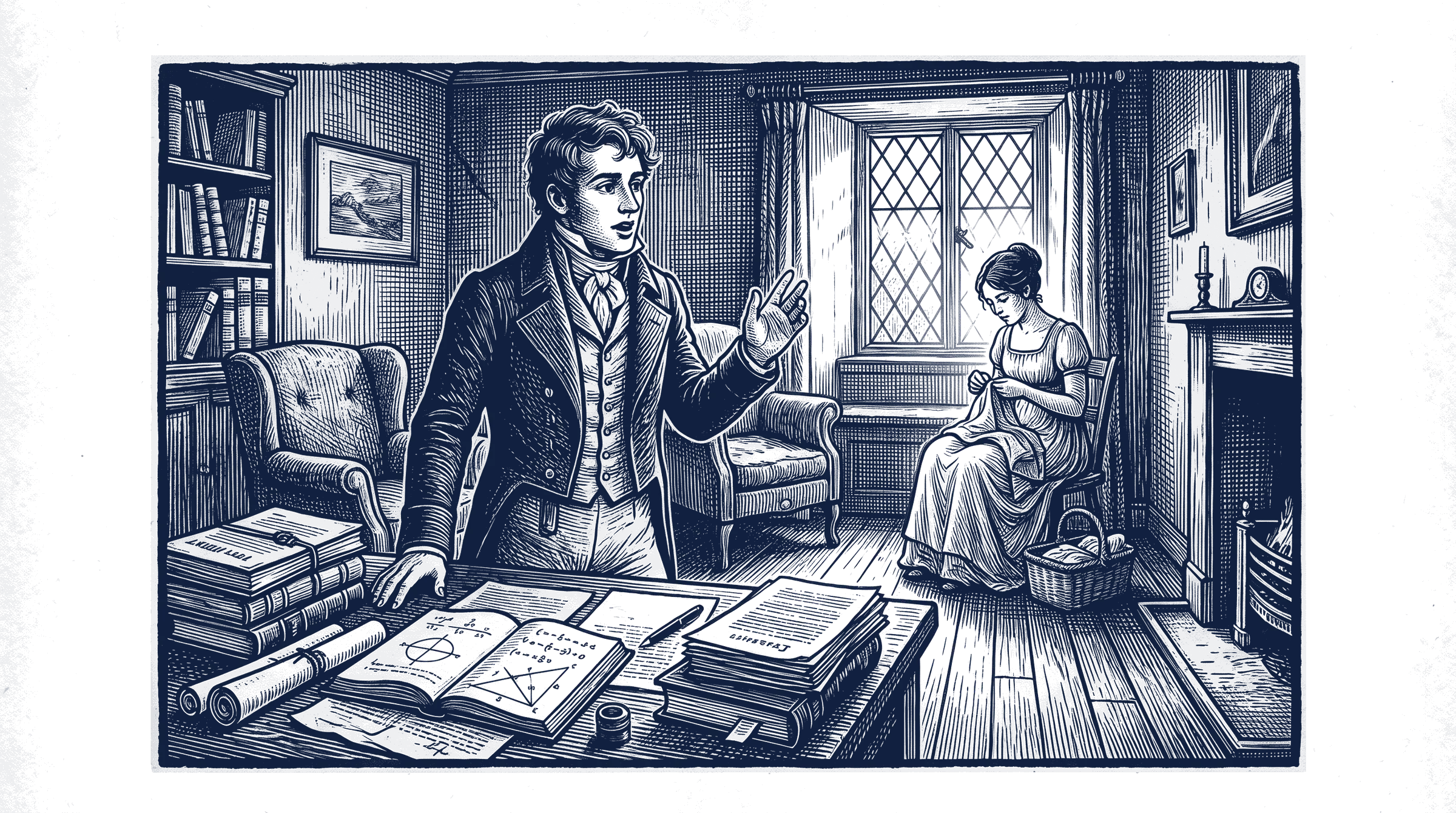
He describes himself over a legal case or an algebra problem, looking for the first setup: the equation from which the solution follows by calculation. That is a first principle in the most literal sense. He finds it by talking to his sister, who sits behind him working and knows neither the law nor the mathematics. He starts with some dark notion, distantly connected to what he wants; if he begins boldly, the need to find an end for a sentence already started presses that confused notion into clarity, until, as I translate him, the insight is finished together with the sentence. Meanwhile he stalls with drawn-out conjunctions and needless appositions, to buy time.
I grant this completely. It undoes the assumption I started from, that I should have the principle before I open my mouth. And it agrees with Aristotle: Kleist's word for the notion he starts with, verworren, means confused.
But Kleist's sentence is aimed. It starts from a notion tied to his question, and what makes the thought is the need to bring a started sentence to its end. His stalling is delay on the way to a goal: in Andreasen's terms, circumstantial. A tangent keeps the momentum and drops the end.
So the line does not run between people who have their first principles before they speak and people who do not. In Aristotle's account, nobody does. It runs between talk in which each sentence still answers to the question, and talk in which each answers only to the one before. I think Kleist's sister mattered because she held the question for him. While someone waits for the end of the sentence, the end stays in the room.
Why aloud is harder than on paper
On paper, the question stays where you wrote it, and you can see that the third paragraph has wandered. Aloud, it was said once. You carry it while building the next sentence, and the sentence you just said is louder than either. Elvevåg's team suggested relating their eight words to the limits of working memory; they did not test it, and I do not know if it is the reason. In an earlier essay about recording myself, I blamed the missing listener. This is the other half: a listener holds the question for you.
Not every tangent is a failure; a conversation that never drifts is an interview. But Andreasen's derailment turns on the speaker not noticing. A tangent you choose is a detour. This essay is about the one you do not notice, at the moment you meant to explain.
What I am not claiming
Rozenblit and Keil studied written explanations of devices by Yale students. Elvevåg and colleagues studied patients and controls. Aristotle wrote about inquiry into nature, not conversation; applying his order of discovery to a spoken sentence is my reading. Kleist's essay reports on himself; it is not an experiment. I do not know whether the first principles slogan makes anyone better at anything. And I have no method for drifting less. This essay tries to see the problem clearly, which is a different thing.
Your last sentence
Go back to your zipper. If your second number was lower than your first, so was theirs: the Yale undergraduates fell from 3.89 to 3.10. You did not forget anything about zippers in a minute. You found out what you had: a name, like round, and not yet its definition.
Then your last sentence. If it was still about the zipper, however slowly you got there, Kleist would have recognised you. If it was about a jacket, or a winter, you made a tangent, and every step of it felt reasonable.
Everyone talks about first principles as the place to start. In Aristotle's account nobody starts there, and Kleist did not. You start with a name, a confused whole, and a sentence that has to be finished. When a first principle arrives, it arrives the way Kleist said, together with the end of the sentence. A tangent is what happens when the sentence ends somewhere else.
Sources. Aristotle, Physics, Book I, translated by R. P. Hardie and R. K. Gaye, The Internet Classics Archive. Rozenblit and Keil, "The misunderstood limits of folk science: an illusion of explanatory depth," Cognitive Science, 2002. Andreasen, "Scale for the Assessment of Thought, Language, and Communication (TLC)," Schizophrenia Bulletin, 1986. Elvevåg, Foltz, Weinberger and Goldberg, "Quantifying incoherence in speech: An automated methodology and novel application to schizophrenia," Schizophrenia Research, 2007. Heinrich von Kleist, "Über die allmähliche Verfertigung der Gedanken beim Reden," written around 1805–06 and published 1878, text at Projekt Gutenberg, dating from Wikipedia; translations are mine. CNBC, "Elon Musk calls this a 'powerful, powerful way of thinking'—but is 'hard to do.' Here's how it works," CNBC Make It, 2020.