

Why the Hitchhiker Giggled: Networking That Works
Most networking advice is a way to get something out of a person. The trick that actually works is cheaper and stranger: talk to people you need nothing from, and ask them a second question.

Before you read on, make a guess.
Tomorrow, on your way to class or work, you have to talk to a stranger for a few minutes. Not anyone useful. Someone wearing a hat, or someone holding a coffee. You walk up to the first one you see and say hello.
Will they talk to you? Answer yes or no. Then put a number on it: out of a hundred people doing the same thing, how many get a conversation with the first stranger they try?
Keep that number. And one more guess: when the conversation is over, will that stranger like you more or less than you liked them?
The giggle in the passenger seat
When I give hitchhikers a ride on the METU campus, I ask them how they are. Most of them giggle first, as if nobody had asked them that before.
I am shy at the start of every conversation, so the giggle caught my attention. I think it explains what most networking advice gets wrong.
Here is the claim of this essay, plainly. The networking trick that actually works is not a trick. It is talking to people you need nothing from, and asking them a second question. Most of us avoid it because we are wrong, in a way psychologists have measured, about how it will go. We expect strangers not to want to talk, and we expect them to like us less than they do. The shyer you are, the more wrong you tend to be.
A bubble where everything needs a use case
I spend most of my time in a bubble of people hustlemaxxing their way through the AI world, building everything at once. I am one of them. In that bubble, everything needs a use case, people included.
Tech events are where this shows most. Everyone arrives with a pitch, and a conversation is two pitches taking turns. You leave with contacts, and each one is a little less charming than the last, for them and for you. That is the catch: a conversation that exists to get something is easy to see through.
Talking to someone in a café, or on the street on the way to class, has no use case. That is exactly why nobody in my bubble does it, and why I think it is the most useful thing on the list.
What the commuters got wrong
In 2014, Nicholas Epley and Juliana Schroeder of the University of Chicago Booth School of Business asked commuters on Chicago trains and buses to do one of three things: talk to a stranger near them, keep to themselves, or commute as normal. The people who talked to a stranger reported a more positive commute than the people who sat in solitude, and no less productive a one.
Then they asked other commuters to predict how it would go. Train commuters said they were more interested in talking to a stranger than they thought other people were. They guessed that 46.4% of their fellow commuters would be willing to talk. In the experiment, every commuter who tried and returned the survey reported talking with the person they approached, and not one reported being rebuffed. Of the bus riders, the authors wrote that a stranger agreeing to talk was "closer to a sure thing" than the coin flip people expected.
Epley and Schroeder suggest the silence keeps itself going: everyone reads the others' silence as disinterest rather than politeness. They connect it to pluralistic ignorance: each person believes the others are less interested in connecting than they are themselves.
In 2022, Gillian Sandstrom, Erica Boothby and Gus Cooney turned the test into a game: a week-long scavenger hunt in which, each day, participants found a stranger who matched a description, such as someone wearing a hat, and talked to them. On the first day, only 40% of the players thought the first person they approached would talk to them. The first person did, 92% of the time. Over the whole week, 1,164 of the 1,336 conversations, or 87%, happened with the first person they approached.
Compare that with your guess.
The liking gap
The second mistake comes after the conversation. In 2018, Erica Boothby, Gus Cooney, Gillian Sandstrom and Margaret Clark published a paper in Psychological Science asking whether people like us more than we think. In their first study, 36 people recruited around Yale University talked in pairs for five minutes. Then each rated how much they liked their partner and how much they thought their partner liked them.
On a seven-point scale, people liked their partners 5.82 on average and believed their partners liked them 5.17. Across a whole group, people cannot like their partners more than their partners like them, so the difference is a mistake. The authors called it the liking gap. In later studies it held after longer conversations, in a sample of the British public, and among first-year college suite mates for several months.
In the first study, the shyer participants were, the larger their gap. The shyest third liked their partners 6.16 and thought they were liked 5.02. The least shy third liked their partners 5.57 and thought they were liked 5.32, a difference too small to count.
The authors also looked at why. The signals of liking were there in the conversation; people were too busy with their own self-critical thoughts to notice them. That is how shyness feels from the inside. When I am shy, I am not watching the other person. I am replaying my last sentence.
The giggle, read again
Here is my reading of the giggle, and it is only a reading. The hitchhiker made the commuters' prediction. A ride is a transaction, so they assumed the driver did not want to talk. "How are you?" breaks that prediction while they are still closing the door.
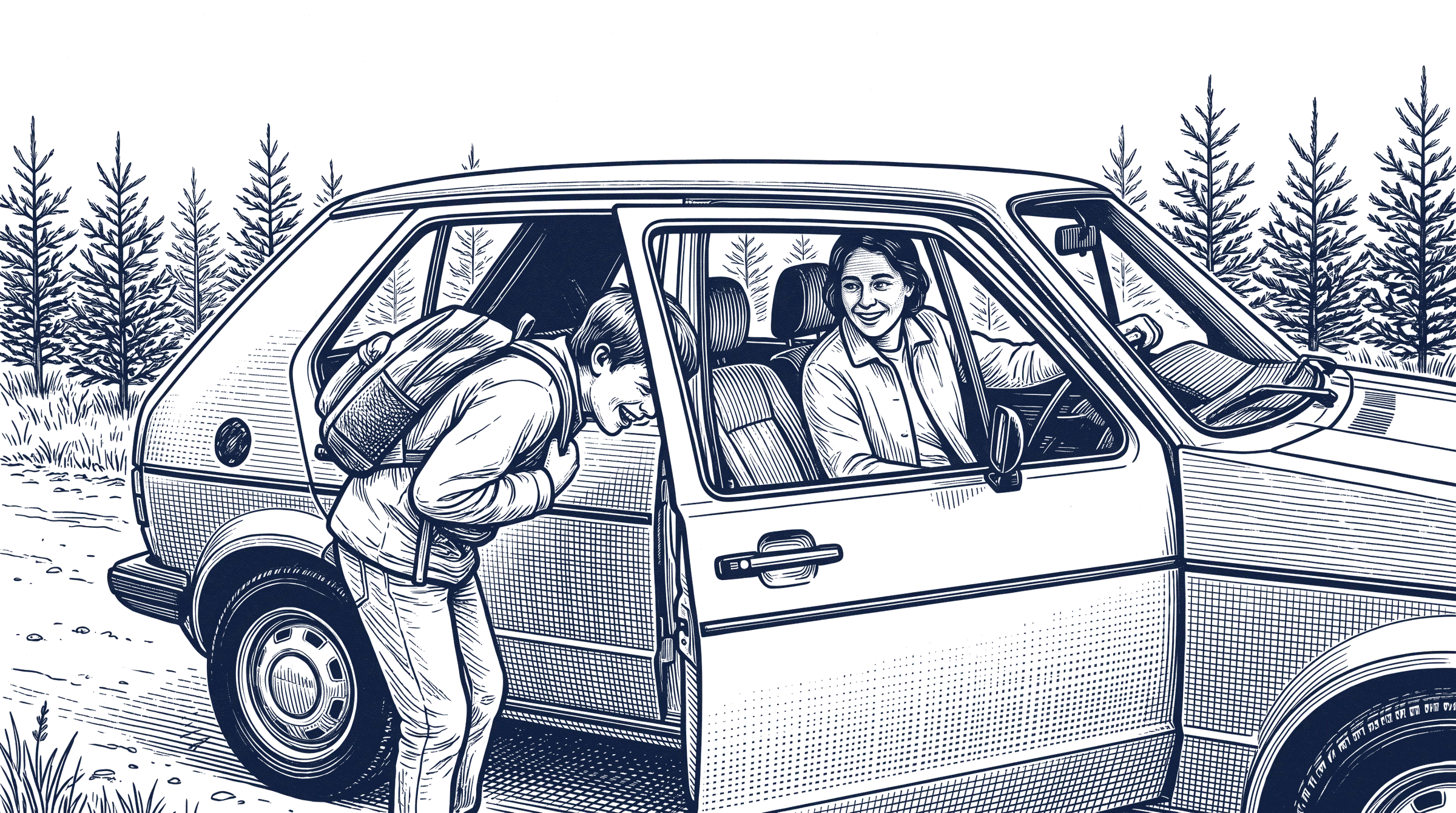
The giggle is the sound of a wrong prediction being corrected.
The strongest objection: a stranger will not fund you
Here is the case against everything above, as strongly as I can put it. This is nice, but it is not networking. Networking is for jobs, investors and cofounders. The person holding a coffee will not fund your company, and tech events are worth the awkwardness because the right people are in the room.
I grant the first half. Nothing I have cited shows that talking to strangers gets anyone a job. Those studies measured mood, liking and fear, not careers.
The closest evidence about careers points somewhere interesting. In 2022, Rajkumar, Saint-Jacques, Bojinov, Brynjolfsson and Aral published in Science an analysis of large randomized experiments on LinkedIn's "People You May Know" feature. They found that moderately weak ties, measured by mutual connections, created the most job mobility. Weak ties increased job mobility in more digital industries; in less digital ones, strong ties did.
Those are LinkedIn connections, not strangers on a bus, and I will not stretch them further. But AI is about as digital as an industry gets, and a bubble where everyone knows the same people and reads the same posts is mostly strong ties.
So I am not saying the café replaces the event. I am saying the skill and the error are the same in both rooms. At the event, everyone brings the same bad forecast, plus a pitch. The café is where you can correct the forecast for free.
Networking tricks with evidence behind them
The title promised tricks, so here are four, each tied to a finding.
Assume they want to talk. Your forecast is probably too low. The players expected a yes 40% of the time and got one 92% of the time.
Ask the second question. Karen Huang, Michael Yeomans, Alison Wood Brooks, Julia Minson and Francesca Gino reported in 2017 that people who asked more questions, especially follow-up questions, were better liked by the people they talked to. A follow-up question is one about what the other person just said. "How are you?" is a greeting. "Wait, why that course?" is a conversation.
Do not trust your review afterwards. The voice replaying your sentences on the walk home is the liking gap, and it is wrong in a known direction.
Do it small and often. In the scavenger hunt, the players' expected rejections fell day by day, while the rejections they actually met did not change. The gain lasted at least a week after the game ended. The fear went down with practice, not insight, so reading this essay does not count.
So why bother?
Because it makes ordinary days better. In a 2014 study by Gillian Sandstrom and Elizabeth Dunn, people sent into a Starbucks to have a real social interaction with the barista, rather than getting in and out, left feeling a greater sense of belonging. Commuters who talked had better rides. Strangers liked their partners more than their partners guessed.
And because rejection is real but rarer than it feels. In the scavenger hunt, about one conversation in eight needed more than one try. That is the true price, and it is lower than the one we pay in advance by never starting.
What I am not claiming
These studies were run in Chicago, around Yale and in Britain, and most measures are what people reported about themselves. I do not know how the numbers translate to Ankara, or to a campus road. My reading of the giggle is untested. And I am not saying every stranger wants to talk, or that you should push past someone who has said no.
Your number
Go back to your guess. If you said the first stranger would not talk to you, you were with most of the scavenger-hunt players on their first day. The first stranger said yes 92% of the time. If you guessed they would like you less than you liked them, that guess has a name now, and it is usually wrong.
Tomorrow someone will get into my car and I will ask them how they are. They will probably giggle. Then I will ask the second question.
Sources. Epley and Schroeder, "Mistakenly seeking solitude," Journal of Experimental Psychology: General, 2014. Boothby, Cooney, Sandstrom and Clark, "The Liking Gap in Conversations: Do People Like Us More Than We Think?," Psychological Science, 2018. Sandstrom, Boothby and Cooney, "Talking to strangers: A week-long intervention reduces psychological barriers to social connection," Journal of Experimental Social Psychology, 2022. Huang, Yeomans, Brooks, Minson and Gino, "It Doesn't Hurt to Ask: Question-Asking Increases Liking," Journal of Personality and Social Psychology, 2017. Rajkumar, Saint-Jacques, Bojinov, Brynjolfsson and Aral, "A causal test of the strength of weak ties," Science, 2022. Sandstrom and Dunn, "Is Efficiency Overrated?," 2014, as reported by Business Insider via Yahoo Finance.